
Robotic Welding Cell with Track Motion
Project Overview
Mexx engineered an automated robotic welding cell for large tubular assemblies, integrating track-mounted robot welding, dual rotary workpiece stations, and separated operator loading zones within one coordinated production system. The project was developed to weld a primary chassis and roll cage assembly together with front and rear sub-assemblies, while maintaining controlled welding quality and allowing loading on one side of the cell while welding continued on the other.
Rather than treating the robot, positioners, welding package, and safety systems as separate items, the project required an integrated cell approach. Robotic motion, coordinated workpiece manipulation, welding process control, fixture access, operator interaction, and safety zoning all had to work together within a compact manufacturing layout.
Engineering Challenge
This project involved welding large and complex tubular structures with high geometric variation, strict access requirements, and tight control over weld material deposition. The specified assemblies included a main roll cage and chassis frame together with two sub-assemblies, and the target material range included steel, stainless steel, Inconel, and potentially titanium. The existing process was based on TIG welding, so the robotic welding solution needed to maintain careful control over deposition while still offering the repeatability and productivity benefits of automation.
Although cycle time was not the main project driver, uninterrupted cell utilisation remained important. Mexx therefore developed the system as a dual-station configuration with two independent safety zones and two workpiece manipulators, so loading and unloading could take place on one side of the cell while welding continued on the other.
Projects of this nature demand careful integration between:
- Robotic arc welding
- Coordinated workpiece manipulation
- Track-mounted robot motion
- Weld process control
- Dual-zone safety architecture
- Fixture access and operator loading
- Assembly variation management
- Installation and commissioning
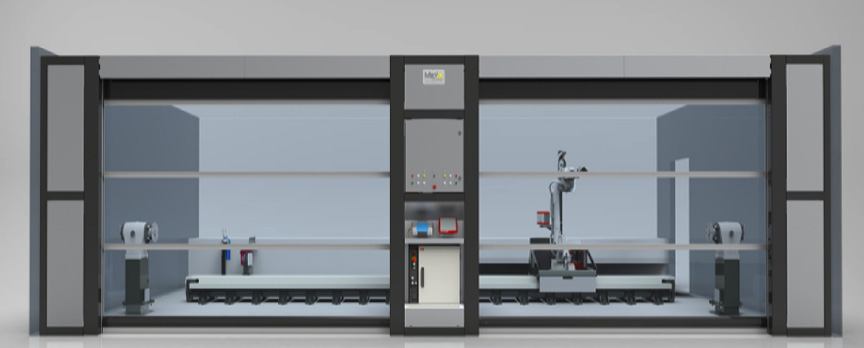
System Architecture
The welding cell integrates several functional elements within one robotic manufacturing station:
- ABB IRB2600ID robotic welding package
- ABB IRC5 controller and FlexPendant interface
- ABB IRBT 2005 interpolation track with single carriage
- Two ABB IRBP L-2000 rotary manipulators
- Integrated Fronius TPS 500i CMT welding system
- Water-cooled torch package and wire feed system
- Torch service centre and automatic TCP calibration
- Dual operator loading stations
- Two independent safety zones with light curtains
- Interlocked maintenance access door
- Programming for one main assembly and two sub-assemblies
The result was a cell layout that allowed the robot to travel along the track, weld across large assemblies, and coordinate motion with both rotary manipulators while maintaining safe separation between active welding and operator loading activities. The weld cell layout drawing and 3D views in the proposal show this clearly, including the track alignment, twin work zones, and the relationship between the robot and each manipulator station.
Welding and Motion Approach
The core robot package was based on an ABB IRB2600ID with integrated dress pack, supported by RobotWare Arc software and mounted on a 7992 mm ABB IRBT interpolation track. This allowed the robot to access larger assemblies than a fixed-base welding robot could normally reach, while coordinating its motion with the rotary workpiece manipulators.
Each of the two ABB IRBP L-2000 rotary manipulators was specified for a 2000 kg capacity, including fixture and workpiece, with maximum workpiece dimensions of approximately 1850 mm diameter by 4000 mm length. These positioners were intended for fully coordinated use with the robot both during programming and during live welding operation.
The welding package itself was based on a Fronius TPS 500i CMT PAP system, selected to support multiple materials and lower-deposition process control. Included features such as the torch service centre, torch cleaning and anti-splatter, automatic TCP calibration, collision sensing, and SmartTac supported reliable robotic welding in a production environment where repeatability and torch condition management matter.
Production and Operator Requirements
A key feature of the project was the use of two independent work zones. Each station included its own light curtains, interlocks, and operator pushbutton set for cycle start, stop, and emergency stop functions. This gave the system practical operator access for loading and unloading while protecting personnel from active welding operations on the opposite side of the cell.
The cell was also designed around real production use rather than just robot motion in isolation. Mexx included a cycle time study on the main roll cage assembly and specified programming for one roll cage variant, one front assembly variant, and one rear assembly variant as part of the project scope. That positions the system as a usable manufacturing cell for multiple welded assemblies rather than a one-part demonstration setup.
Mexx Engineering Delivery Method
Complex robotic welding systems require disciplined engineering governance. Even when the final installation is a single welding cell, the project still depends on coordinated decisions across welding process selection, robotic reach, manipulator sizing, safety zoning, access, controls, and commissioning.
Mexx approached this project as a complete engineered cell, covering design, manufacture, installation, commissioning, and operator training, together with programmed assembly variants and integration of the robot, track, positioners, and welding package into one working system.
This structured approach helps reduce late-stage redesign, improves coordination between disciplines, and gives clients greater confidence in automated welding projects that need to perform reliably in real manufacturing conditions.
Disciplines Involved
Projects of this scale require collaboration across multiple engineering domains.
- Mechanical engineering
- Automation and controls
- Robotics integration
- Welding process engineering
- Safety systems and guarding
- Workpiece manipulation and fixturing
- Installation and commissioning
- Operator training and support
Discuss a Similar Project
Mexx delivers both large automation systems and focused manufacturing cells where a specific production process needs a robust engineered solution. Projects like this demonstrate how robotics, coordinated positioners, welding process control, and practical operator access can be combined into an efficient and repeatable fabrication cell.
If you are planning a robotic welding, fixturing, manipulation, or fabrication automation project, Mexx can assist with concept development, system architecture, feasibility definition, and delivery planning.