
Automated Tray Washing, Stacking and Palletising System for Agriculture
Project Overview
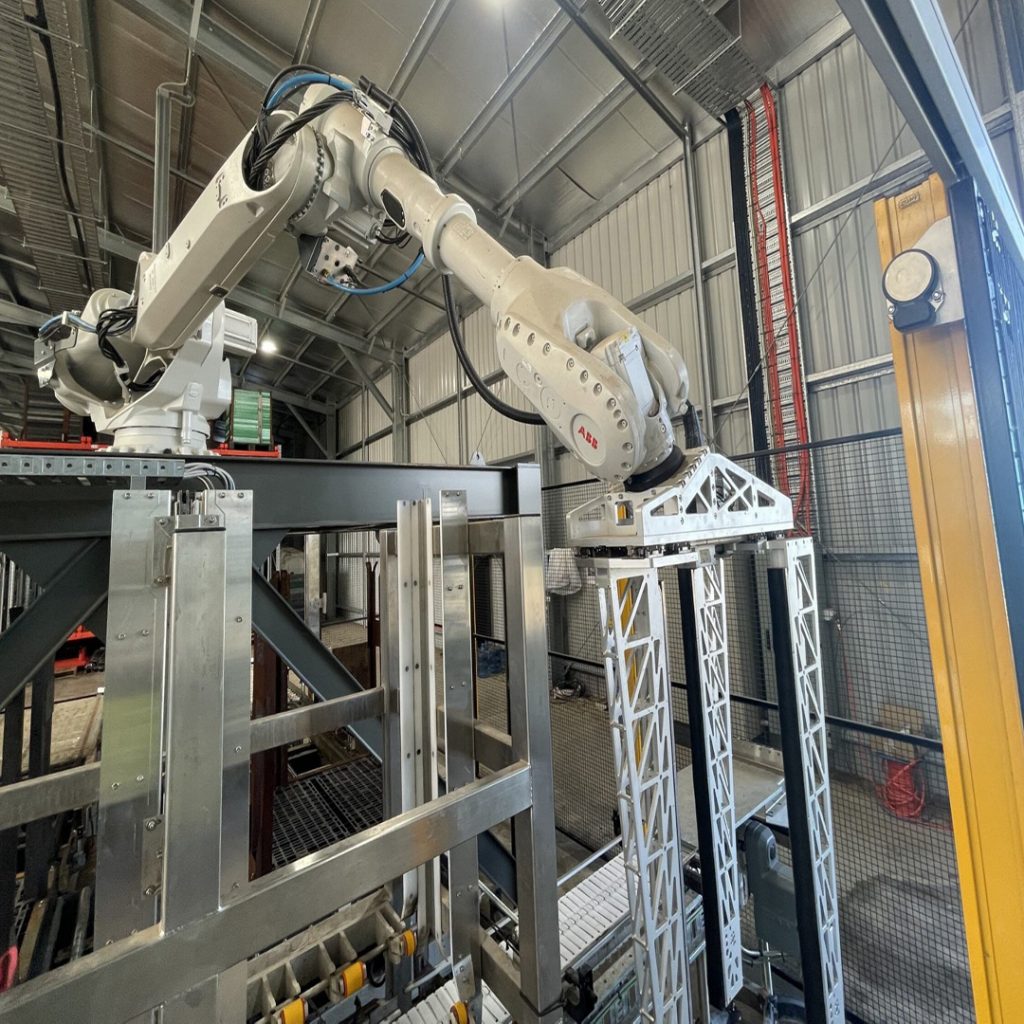
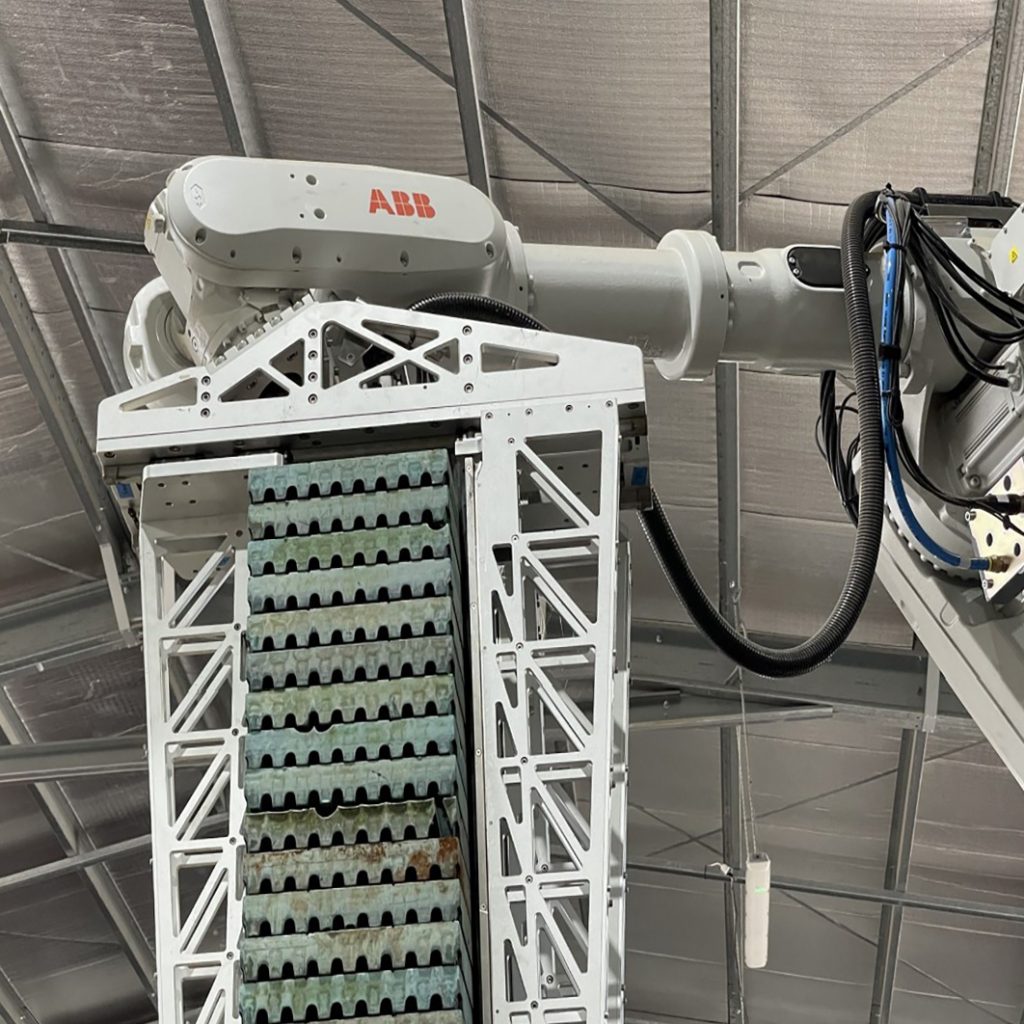
Mexx engineered an automated tray handling and rack management system for a seedling production facility, supporting tray flow through washing, storage, seeding, and finished tray palletising. The project combined automated tray stacking, pallet handling, robotic de-palletising and palletising, rack de-stacking and re-stacking, conveyor integration, and centralised control into one coordinated production system.
Rather than treating tray washing, seeder infeed, and finished tray handling as separate pieces of equipment, the system required an integrated approach across production flow, material handling, operator access, automation architecture, and safety. This made it a practical example of industrial automation applied in a live agricultural environment, where throughput, reliability, and handling consistency matter just as much as they do in more traditional manufacturing sectors.
Engineering Challenge
Seedling production environments require trays and racks to move reliably between washing, storage, unloading, seeding, and palletising without creating bottlenecks, ergonomic issues, or inconsistent handling. The system needed to accommodate repeated tray movement at high rates, manage multiple tray variants, maintain safe operator interaction, and support stable downstream feeding into the seeding process. The original tray management proposal targeted at least 1500 trays per hour and aimed for 3000 trays per hour across the system.
An additional challenge sat around the rack washing interface. Racks arrived stacked high for forklift handling, but trays needed to be unloaded at an ergonomic working height to reduce manual handling risk. The rack de-stacker and stacker scope was therefore developed to singulate racks, present them safely for tray unloading, manage dislodged trays, and then re-stack racks after washing for efficient downstream handling. This was not laboratory automation. It was robust industrial automation designed for an agricultural production setting with real material flow, real operators, and real site constraints.
Projects of this nature demand careful integration between:
- Agricultural production flow
- Tray and rack material handling
- Robotic palletising and de-palletising
- Conveyor transfer systems
- Seeder interface integration
- Ergonomic operator access
- Centralised control and interlocks
- Safety zoning and guarding
System Architecture
The automated production system integrates several functional stages within a single handling architecture:
- Tray stacking and palletising on storage infeed
- Robotic tray de-palletising for seeder supply
- Tray de-stacking for controlled seeder infeed
- Manual tray loading interface at ergonomic working height
- Seeded tray stacking and palletising on seeder outfeed
- Rack de-stacking from high forklift-loaded stacks
- Rack presentation through tray unloading and washing interface
- Rack re-stacking for organised downstream handling
- Conveyor transfers including pallet and rack movement
- Centralised PLC and HMI-based control across the system
The design allowed trays, pallets, and racks to move between washing, storage, seeding, and finished handling stages in a controlled sequence while maintaining production continuity, operator safety, and repeatable system performance.
Production and Handling Requirements
Mexx developed the system around the operational requirements provided for the facility. These included automated tray movement from the tray washing line into storage, automated transfer from storage into the seeding systems, automated palletising on the output of the seeders, modularity for future expansion, and practical accommodation of manual loading where required. The system also had to manage racks loaded up to 12 high and re-stack them to 6 high after washing.
In practical terms, the project sat at the intersection of agricultural handling and industrial automation. It needed to support day-to-day nursery production, but with the discipline, repeatability, and systems integration normally associated with automated manufacturing lines.
Automation Approach
The tray handling scope included robotic palletising and de-palletising using ABB robotic systems, tray stackers and de-stackers, pallet conveyors, tray variant handling, and a centralised Omron-based PLC and HMI control platform to manage system communication, recipes, safety, and interlocks. The cycle time analysis in the proposal showed the design intent was to maintain nominal seeder feeding rates while providing buffer capacity in key handling stages.
The rack handling scope used servo-controlled rack lifting and engagement mechanisms to separate stacked racks, present them at a safer unloading height, and then re-stack them after washing. Integrated conveyors and transfer systems allowed the rack handling section to connect practically with the wider tray process, rather than operating as an isolated manual work zone.
This combination of robotics, conveyor handling, servo mechanisms, and centralised controls is exactly what makes automation relevant to agricultural production. Where product flow is repetitive, labour-intensive, safety-sensitive, or throughput-critical, the same engineering principles used in manufacturing can be applied successfully in horticultural and primary production environments.
Mexx Engineering Delivery Method
Complex handling and automation systems require disciplined engineering governance. This is especially true when a project spans agricultural production operations, manual interfaces, robotics, safety systems, and multiple transfer stages. The value is not only in the equipment itself, but in how the system is defined, integrated, and delivered.
Mexx delivers projects using a structured stage-gate approach aligned with recognised project management principles. Each stage focuses on reducing uncertainty, defining system architecture, and retiring technical risk before major capital commitments are locked in. That broader project philosophy is already established across the Mexx website and is intended to carry through into project pages like this one.
Typical stages include:
- Concept definition and production flow architecture
- Feasibility and throughput assessment
- Safety and risk identification
- Detailed mechanical and controls design
- Integration planning across handling and process equipment
- Manufacturing and assembly
- Factory acceptance testing
- Installation and commissioning support
This structured approach helps reduce late-stage redesign, improves coordination between disciplines, and gives clients greater delivery confidence for complex automated handling systems in both industrial and agricultural settings.
Disciplines Involved
Projects of this scale require collaboration across multiple engineering domains.
- Mechanical engineering
- Automation and controls
- Robotics integration
- Conveyor and materials handling design
- Safety systems and guarding
- Production system architecture
- Operator interface design
- Commissioning and operational support
Discuss a Similar Project
Mexx specialises in integrated production, plant, and automation systems for clients operating in practical industrial environments, including agricultural processing, materials handling, and manufacturing. Projects like this show that robotics and automation are not limited to sterile or highly controlled industries. They can also be applied effectively where products, racks, pallets, and operators need to move through real production workflows safely and consistently.
If you are planning an automated handling, washing, stacking, palletising, or process support system, Mexx can assist with early-stage concept development, system architecture, feasibility definition, and delivery planning.