
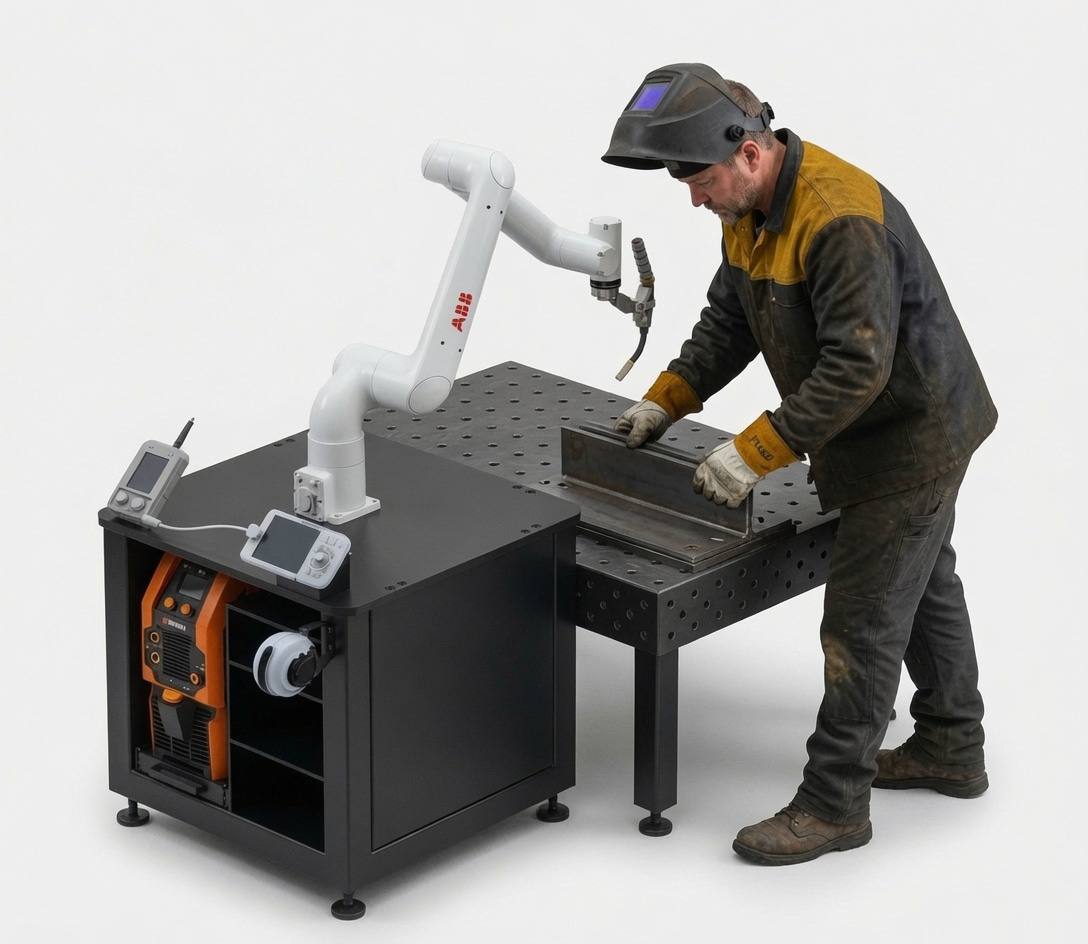
A welding cobot will do 80% of the job easily. It’s the last 20% that sinks most projects and that 20% was never the robot’s job.
I’ve watched plenty of welding-robot projects in Australia start with excitement and end in a corner gathering dust. The robot wasn’t faulty. The expectation was.
Here’s the pattern. A company buys a welding robot expecting it to replace a welder and to walk up, push go, and have it do the whole job. And for the long, straight, repetitive runs, it’s brilliant. That’s the easy 80%: the hot, boring, fume-filled passes a robot does tirelessly and consistently.
Then they hit the last 20%, and it’s brutally hard for a robot, because robots can’t think:
- Parts that don’t fit up the same way twice. A robot welds the path it was given. If the joint isn’t where the program expects, it welds fresh air or drives the tip into the steel.
- Tack-up and fixturing. Getting parts held accurately and repeatably is the make-or-break, and it takes a tradesperson’s judgement.
- Odd one-offs, awkward access, the “you just know how to do this” welds. Variation is exactly what robots are worst at.
And here’s the thing: that 20% is easy for your boilermaker. Reading the job, fixturing it, tacking it accurately, that’s bread and butter for a skilled hand. It’s only “hard” if you expected the robot to do it.
So the projects that fail are the ones that tried to automate 100%. The ones that succeed treat the cobot as an offsider: the welder sets up and tacks the job (the skilled 20%), the cobot runs the long welds (the grunt 80%), and the welder moves to the next setup. You’re not removing the tradesperson, you’re multiplying them.
Get that split right and a cobot pays for itself. Get it wrong, expect it to replace the welder, and it ends up in the corner.
Thinking about a welding cobot?
MexxBot is built around this split: your welder does the skilled setup, the cobot does the repetitive welding. We’d rather you buy one that gets used than one that disappoints.