
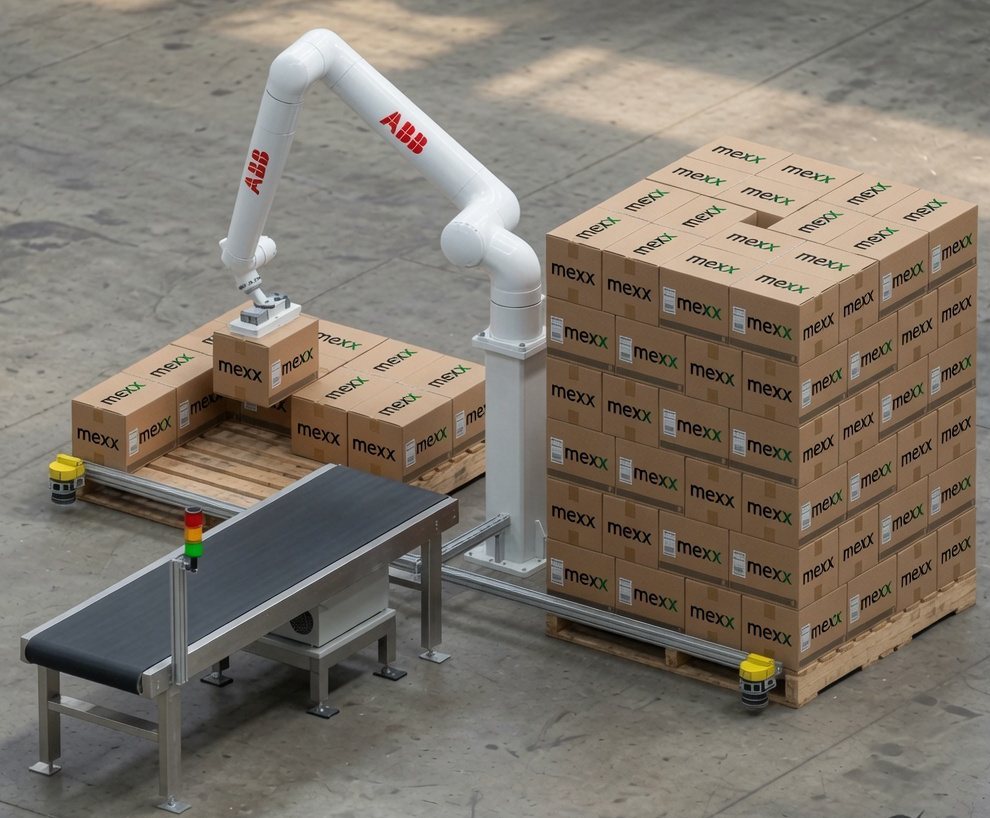
On a palletising cell, the robot is rarely what decides whether it works. Most of the time it’s the few metres of conveyor in front of it.
That catches people out. The arm is the expensive bit, so it gets the attention. But a palletising robot is a straightforward piece of equipment doing a straightforward job. What it needs is for the product to turn up the same way every time.
What the robot needs from the line
A palletising robot isn’t clever. It’s precise, tireless and completely literal. It picks from exactly where you told it to pick, at exactly the moment you told it to.
So four things matter on the infeed:
Position. The carton needs to arrive in the same spot each cycle. A robot doesn’t glance down and adjust, it goes where the program says.
Orientation. Vacuum grippers are sized to the top face of the carton. Turn that carton ninety degrees and the pads are no longer over the same area, so the seal drops off and the lift becomes marginal.
A gap between products. The gripper needs clearance to come down around the carton. Product arriving nose-to-tail leaves nowhere to get in, and you end up either slowing the line or nudging the next box along.
A stop that repeats. This one is easy to underestimate. Backpressure from product queued behind will push the front carton past a simple stop, and a few millimetres of creep each cycle shows up as missed picks.
Worth adding: vacuum likes a clean, flat, sealed surface. Crushed tops, tape ridges down the centre, loose shrink wrap or condensation off a chiller all reduce how much grip you get. None of it is a dealbreaker, it just needs to be known before the gripper is chosen, not after.
Why this isn’t obvious
Because the person currently doing the job handles all four without anyone having to think about it.
A carton comes down skewed and they square it up. Two arrive stuck together and they separate them. One’s damaged and it goes to the side. They adjust their timing to the line without being told. That’s genuine skill, built up over years, and it’s invisible precisely because they’re good at it.
It doesn’t appear in the throughput figures. It isn’t written down anywhere. From the outside the line simply looks like it runs well, and it does, because someone is making it run well.
When you automate that station, that skill has to be replaced by engineering. Not because anything was wrong before, but because a machine can’t improvise the way a person can.
Worth twenty minutes before you spec anything
Stand at the end of the line and watch.
- How consistently does product arrive in the same position?
- Does the orientation stay the same, or does it vary?
- Is there a reliable gap, or does it bunch up?
- How often does someone reach in and adjust something?
If it runs clean and consistent, palletising is a good automation job and the payback is usually quick, it’s one person per shift, every shift, and the robot doesn’t slow down at hour seven.
If there’s a fair bit of hand-correcting going on, that’s not a reason to walk away. It just means some of the budget belongs in the infeed rather than all of it in the arm. Better to know that at the quoting stage than after commissioning.
How we’ve set it up
This is why we quote in-feed conveyors separately on the MexxBot Pal rather than including a standard one. Product size, weight, rate and line layout vary so much between sites that a one-size conveyor would be wrong more often than right, and the wrong infeed undoes an otherwise good cell.
The robot itself is a genuine ABB collaborative arm running the same FlexPendant and OmniCore controller as ABB’s industrial robots, from $77,100 +GST. That part is well proven.
The part worth thinking about carefully is what happens in the few metres before it.